This project was bigger than I knew.
I've been compiling information, and struggling with finding the time to upload it. It seems like any time I sit down to write in this blog, I remember that I have some other homework to do, some other project to work on.
My residency has been extended until April 15th. I think it's fitting given the fact I'm researching accessibility in the arts. It's something I will always have trouble accepting but, I do need more time than most, to get to the same point. I need assistance, I need understanding, I need support. I'm lucky, that the reading room has been really accommodating and has let me take a bit more time.
So while I was researching disabled people in the arts, art centered around disability, accessible ways to record research and put the information out there, I realized that... I have to put my own info out there in an accessible way as well. So I started researching people that have put out zines and art in different ways.
Content Warning: Child Sexual Abuse: This is a zine that was turned into a video for people that have issues reading.
Resonance Audio Distro has an awesome collection of audio zines
This zine was made by visually impaired teens.
Sarah Tea Rex has put all of their zines in pdf format on this site, and the get a grip zine is also available in braille.
An article about Roy Nachums braille paintings for the blind.
A free braille converter for 3d printing.
3D printed braille and picture books for blind children.
A free braille slate file to 3D print.
Ivona is a text to speech site that lets you pick voices in any language, including French Canadian.
More info on the way!
Heather

Saturday, March 26, 2016
Monday, March 21, 2016
website updates
!!!
Hi.
I've been updating heathrr.ca all day because I've been slacking. I'm guessing, that everyone else is as swamped by finals, but if you find the time go check out some of the updates.
I did a review of DEFINITELYREALALLTIMETRUETALES@LOYOLACAMPUS.COM which was a performance that happened in Feb at Loyola campus, that I helped out on... so it's a biased review, but a review anyways.
Slowly but surely, I'm compiling a zine of all the research I've done in regards to accessibility, and I'm going to be putting it out in PDF, Audiozine and paper format.
I'll update again tomorrow.
- Heathrr
Hi.
I've been updating heathrr.ca all day because I've been slacking. I'm guessing, that everyone else is as swamped by finals, but if you find the time go check out some of the updates.
I did a review of DEFINITELYREALALLTIMETRUETALES@LOYOLACAMPUS.COM which was a performance that happened in Feb at Loyola campus, that I helped out on... so it's a biased review, but a review anyways.
Slowly but surely, I'm compiling a zine of all the research I've done in regards to accessibility, and I'm going to be putting it out in PDF, Audiozine and paper format.
I'll update again tomorrow.
- Heathrr

Monday, March 7, 2016
Update
The website is aliiiive.
heathrr.ca
Go there to check up on what I'm doing in a more visual and less written sense. Also, the icons are all draggable so, drag em around.
I've also been keeping a book list;
-Lists: To-dos, Illustrated Inventories, Collected Thoughts, and Other Artists
-Figurations of Violence and Belonging: Queerness, Migranthood and Nationalism in Cyberspace and Beyond
-Conversation pieces: Community and Communications in Modern Art
-Being on line, net subjectivity
-The uncanny: Experiments in Cyborg Culture
I'm posting art by inspiring artists that (i think) deserve representation.
And I just added a few things to my workspace installation in the FARR.
Heather
heathrr.ca
Go there to check up on what I'm doing in a more visual and less written sense. Also, the icons are all draggable so, drag em around.
I've also been keeping a book list;
-
-Figurations of Violence and Belonging: Queerness, Migranthood and Nationalism in Cyberspace and Beyond
-Conversation pieces: Community and Communications in Modern Art
-Being on line, net subjectivity
-The uncanny: Experiments in Cyborg Culture
I'm posting art by inspiring artists that (i think) deserve representation.
And I just added a few things to my workspace installation in the FARR.
Heather
Monday, February 29, 2016
Hey, I'm Heather
Okay, now for the intro.
Hey, I’m Heather Ross, and I’m the newest resident of the Fine Arts Reading Room. I’m starting off a little bit later than I should have due to an injury, but as it stands, I have 4 weeks left in my residency.
I’ll be setting up a website this week and linking it to this blog, throughout the residency I’ll be compiling a zine, and I also have an installation in the FARR which will change and grow every day I’m here.
About my project
I’m researching something really broad, I want to learn and talk about accessibility in artist and research spaces, and how technology has affected that. I’m focusing on marginalized* groups, and how they access information differently because of technological growth in all formats. I’m focusing on everything from 3D printing paintings for the blind, to how education is accessed, to how research is done by a person with a disability (hello, thats me, I am one of the people with a disability, I'll get into that another time), to people in wheelchairs who gather on second life just to fly. I will be documenting my findings in multiple different ways, whatever feels right, whatever way is relevant.
If you do get the chance to check out my installation in the FARR, you’ll notice it’s pink, girly, child-like. I myself work with electronics on a regular basis, and have felt like I’ve needed to hold back femininity in my work to be taken seriously. I’m over it. I also have felt influenced by the DIY nature of cyber/net art, and the idea that art can be not only playful, but personal. A computer can be an extension of self, in the same sense, I believe a work space can show personality and tell a story. In Jon Rafmans paintings “You Are Standing in an Open Field”, he shows a series of messy desks, just by looking at each one you can tell what type of person it belongs to. I love that. I love that no matter how sterile technology looks, there are millions of cases, covers, stickers, wallpapers, keyboards, customization tools. You give a person something, and they’ve gotta make it their own.
I hope you enjoy following my process
- Heather
*Marginalization is social disadvantage and relegation to the fringe of society. It is used across disciplines including education, sociology, psychology, politics and economics.
Hey, I’m Heather Ross, and I’m the newest resident of the Fine Arts Reading Room. I’m starting off a little bit later than I should have due to an injury, but as it stands, I have 4 weeks left in my residency.
I’ll be setting up a website this week and linking it to this blog, throughout the residency I’ll be compiling a zine, and I also have an installation in the FARR which will change and grow every day I’m here.
About my project
I’m researching something really broad, I want to learn and talk about accessibility in artist and research spaces, and how technology has affected that. I’m focusing on marginalized* groups, and how they access information differently because of technological growth in all formats. I’m focusing on everything from 3D printing paintings for the blind, to how education is accessed, to how research is done by a person with a disability (hello, thats me, I am one of the people with a disability, I'll get into that another time), to people in wheelchairs who gather on second life just to fly. I will be documenting my findings in multiple different ways, whatever feels right, whatever way is relevant.
If you do get the chance to check out my installation in the FARR, you’ll notice it’s pink, girly, child-like. I myself work with electronics on a regular basis, and have felt like I’ve needed to hold back femininity in my work to be taken seriously. I’m over it. I also have felt influenced by the DIY nature of cyber/net art, and the idea that art can be not only playful, but personal. A computer can be an extension of self, in the same sense, I believe a work space can show personality and tell a story. In Jon Rafmans paintings “You Are Standing in an Open Field”, he shows a series of messy desks, just by looking at each one you can tell what type of person it belongs to. I love that. I love that no matter how sterile technology looks, there are millions of cases, covers, stickers, wallpapers, keyboards, customization tools. You give a person something, and they’ve gotta make it their own.
I hope you enjoy following my process
- Heather
*Marginalization is social disadvantage and relegation to the fringe of society. It is used across disciplines including education, sociology, psychology, politics and economics.
3D Printed Paintings
Hey!
I’ve rewritten this intro blog post nearly 20 times, each time I give this long explanation of who I am and why that matters and blah blah blah but I will do that another time becaaaaaause,
I have a friend doing some seriously amazing stuff and I kind of get to be the first to talk about it.
About a year ago, my friend Nathan bought himself a 3d printer, and I was thrilled because at the time that was exactly what I needed. I had the file to print, I had the black glitter filament ready to go, I just needed to find someone to help me finish and so he and I started on our overnight journey to finishing the case for my midi controller, it took way too many tries, and it ended up a little iffy, but I love that midi controller like my kid, and I have him to thank for it.
Nathan Lefsrud been working with High School students in a fine arts class to 3D print classical paintings for the blind. Inspired by this article (http://www.iflscience.com/technology/3d-printing-brings-paintings-and-photography-blind-people), Nathan is working to integrate 3D printing into the high school art curriculum in Alberta. In this example, he used Blender to layer and texture the different components of Ludolf Backhuysen's "The Coming Squall."


You can find more info about this project and more of Nathans work on his teaching blog, https://2teacher4u.wordpress.com/high-school-fa-3d-classic-paintings/ and on thingiverse http://www.thingiverse.com/thing:1378056
- Heather
I’ve rewritten this intro blog post nearly 20 times, each time I give this long explanation of who I am and why that matters and blah blah blah but I will do that another time becaaaaaause,
I have a friend doing some seriously amazing stuff and I kind of get to be the first to talk about it.
About a year ago, my friend Nathan bought himself a 3d printer, and I was thrilled because at the time that was exactly what I needed. I had the file to print, I had the black glitter filament ready to go, I just needed to find someone to help me finish and so he and I started on our overnight journey to finishing the case for my midi controller, it took way too many tries, and it ended up a little iffy, but I love that midi controller like my kid, and I have him to thank for it.
Nathan Lefsrud been working with High School students in a fine arts class to 3D print classical paintings for the blind. Inspired by this article (http://www.iflscience.com/technology/3d-printing-brings-paintings-and-photography-blind-people), Nathan is working to integrate 3D printing into the high school art curriculum in Alberta. In this example, he used Blender to layer and texture the different components of Ludolf Backhuysen's "The Coming Squall."


You can find more info about this project and more of Nathans work on his teaching blog, https://2teacher4u.wordpress.com/high-school-fa-3d-classic-paintings/ and on thingiverse http://www.thingiverse.com/thing:1378056
- Heather
Sunday, November 1, 2015
The Dawn of Collage!
There are a few factors that must be present for collage to exist sustainably. First of all, there's got to be paper. Vellum can hold a lot of gold leaf and gems, but we'll consider that a type of assemblage, since collage is really about thin, layered sheets of plant fibre. Secondly, there's got to be a lot of paper lying around. It can't be too precious or no one could bear to chop it up. Finally, collage needs an elaborate system of visual sign-language that it can absorb and respond to. Just like any art, collage thrives in the cracks of complex social structures, especially the nooks and crannies of luxury and leisure, since it technically does destroy other resources in order to exist.
One of the problems with tracing collage history back to its birth is that paper decays pretty quickly compared to other media. So I can't show you the Chinese collages that appeared around the same time as paper itself(~200BC). The oldest thing I've found is some really lovely 10th century Japanese chigiri-e
During the Heian period, Japanese manuscripts started to include chigiri-e, a torn-paper overlay method. The most famous example is are the heavily decorated manuscripts of the works of the 36 Immortals of Poetry. Here are some examples from the Nishi-Honganji collection:


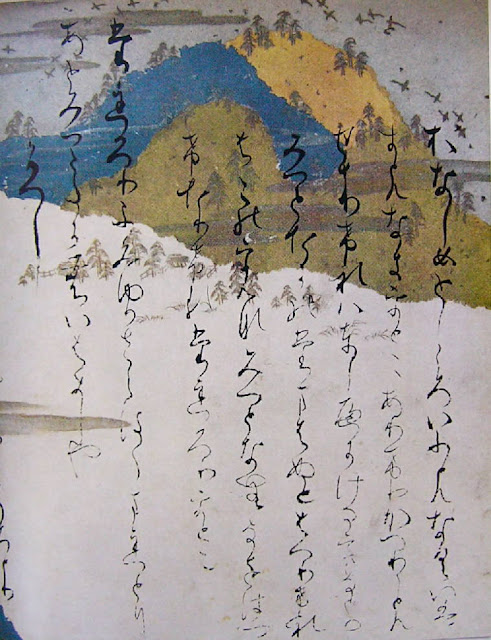
One of the problems with tracing collage history back to its birth is that paper decays pretty quickly compared to other media. So I can't show you the Chinese collages that appeared around the same time as paper itself(~200BC). The oldest thing I've found is some really lovely 10th century Japanese chigiri-e
During the Heian period, Japanese manuscripts started to include chigiri-e, a torn-paper overlay method. The most famous example is are the heavily decorated manuscripts of the works of the 36 Immortals of Poetry. Here are some examples from the Nishi-Honganji collection:

from the 1st volume of collected poems of Ōnakatomi no Yoshinobu (921–991), Artist Unknown

two pages of the collected poems of Minamoto no Shigeyuki (?-ACE 1000), Artist Unknown

a page from 1st volume of collected poems of Lady Ise (10th century), Artist Unknown
Eventually manuscript decoration moved towards painted scrolls, and chigiri-e became less common, but it is still practiced today.
Next week, we'll be jumping all the way to the Victorian era. While there are many cultures who meet my 3 collage criteria in the intervening period, the records are scattered or have decayed. If I find anything I haven't found before I'll post about it here.
Update: Found some Persian Court pages style from ~1500 where panels are mounted on a patterned "album page". Close 2 collage but not quite... I'll keep checking it out!
Update: Found some Persian Court pages style from ~1500 where panels are mounted on a patterned "album page". Close 2 collage but not quite... I'll keep checking it out!
See you @ the club!
Paige
Fruits of the Farr This Week
Hi All! Just thought I'd share some cool things I found at the FARR this week! Enjoy!
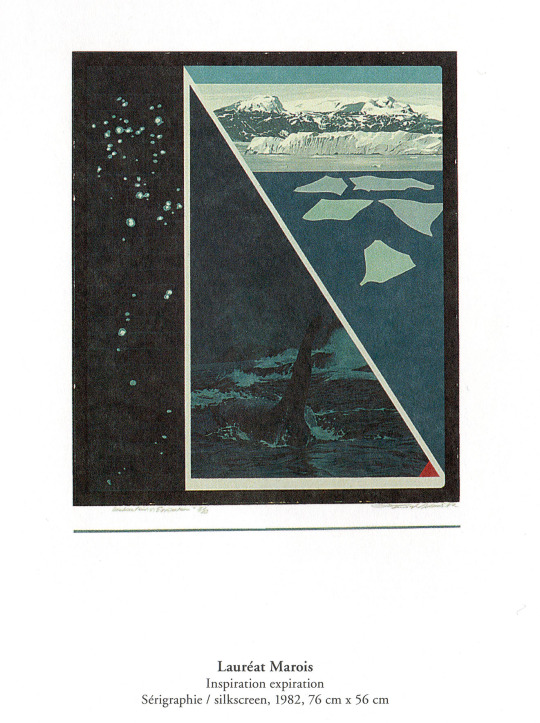
Laureat Malois in Code of ethics for original printmaking (2000)

from Early Canadian Pottery , 1971

from Rachel Whiteread

maquette by S.J. Witkiewicz from 13th International Biennial of Tapestry, 1987

from Henri Matise: A Retrospective, 1951
I'll keep posting all the cool collage work I find! I've only gone through one shelf so far...

maquette by S.J. Witkiewicz from 13th International Biennial of Tapestry, 1987

from Henri Matise: A Retrospective, 1951
I'll keep posting all the cool collage work I find! I've only gone through one shelf so far...
Subscribe to:
Posts (Atom)